Psalm 90:17 — “Let the favor of the Lord our God be upon us…”
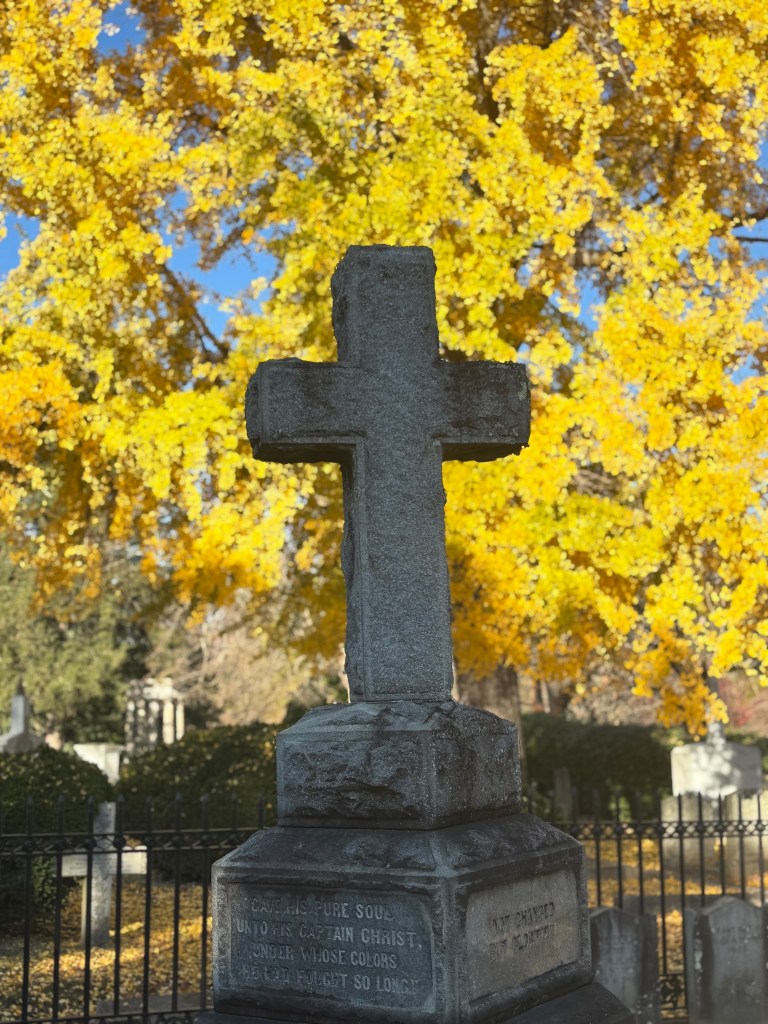
I often drive through Hollywood Cemetery as part of my morning devotional. It is a place where stillness speaks, where time slows down just enough for the heart to listen. This morning, I also went looking for the last gifts of fall—hoping to catch a glimpse of color before winter settled in. But as I made my way down the winding paths, I noticed that most, if not all, of the trees had already surrendered their leaves. Their color had faded. Their branches stood bare under a blue sky, quiet and almost resigned.
But then—there it was.
Tucked away on a little rise stood a single golden tree. Bright. Defiant. Glowing like a lamp in the early morning light. It had held on to its beauty when every other tree had let go. And as I stood there looking at it, I felt something stir inside me.
This is what we do, isn’t it? We move through the days searching—sometimes wandering—hoping to find something bright, something meaningful, something that reassures us that life still holds wonder. We look for purpose. We look for hope. We long for something that will anchor us when the world feels gray or empty.
And so often, we look everywhere but the one place that truly satisfies.
That golden tree reminded me that Jesus is the One thing that never fades. Everything else loses its color. Everything else eventually falls away. But Christ remains.
In Him, the light is never out of season. In Him, grace is never bare. In Him, there is always beauty, always purpose, always life.
Walking away from that tree, I realized that what I was really searching for that morning wasn’t autumn color—it was a reminder of God’s faithfulness. And God, in His kindness, offered it in the form of one stubborn tree standing bright against the November sky.
Maybe today you’re looking for something—a sign of hope, clarity in a confusing season, a sense of meaning in the middle of ordinary hours.
Look to Jesus. He is the golden tree in every landscape. He is the One who stands steady when all else changes. He is the beauty that does not fade.
Prayer: Lord, thank You for meeting us in unexpected places. Help us to look for You with open eyes and open hearts. When the world around us feels faded, remind us that Your presence is still bright, still faithful, still enough. Amen.
I have neuropathy in my feet. They often tingle and feel numb. Over the years, I’ve had several knee surgeries, two shoulder surgeries, and trigger finger procedures. My doctor says I have poor connective tissues. Luckily, at age 60, I haven’t experienced much arthritis yet. I say yet because I do have a prescription for a muscle relaxer for my neck and back. Needless to say, as I’ve aged, my body sometimes aches, and it moves more slowly.
For nearly 35 of those 60 years, I have led the same Baptist church in Richmond, Virginia—Pine Street Baptist Church. It has been my only pastorate since I left seminary. I fell in love with the congregation and community when I first arrived, but I never imagined I would spend a lifetime here. My wife and I came as newlyweds, and we are now grandparents.
A lot can change in 35 years: the church, the community, and us. Even with stiff joints, I can still walk up the stairs to my office on the second floor of the church building. We have an elevator, but it’s mainly for the older folks and the kids who enjoy pressing the buttons. My office chair has molded to fit my body and tends to lean one way, just like I do. I do redecorate my office now and then, moving the pictures on the wall to give it a fresh look.
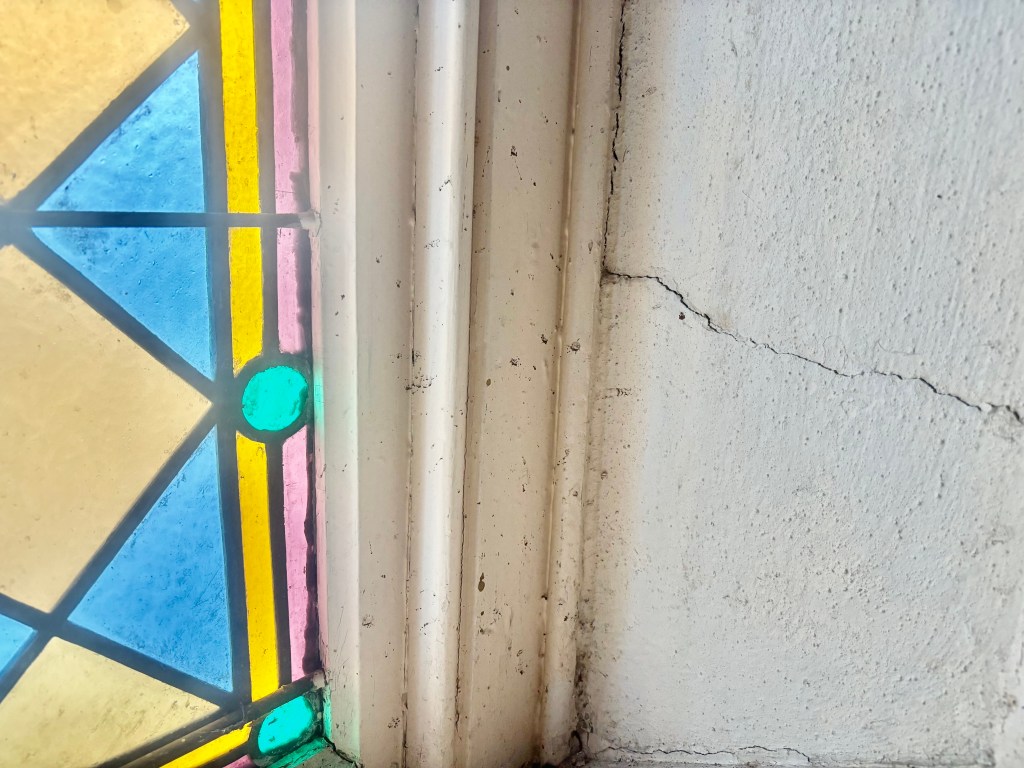
The church is old. 170 years. Being the pastor of Pine Street is to live daily with the weight of time. The building itself carries its history in its walls. Every brick seems to whisper the prayers and songs of those who came before us. But as the years press on, the building shows its age. The cracks in the plaster, the shifting of old stone, the strain on beams and foundations—they are small reminders that even sacred spaces bear the marks of wear.
I cannot look at those cracks without also seeing the ones in us. People carry fractures too. Relationships strain under disappointment. Words once spoken in love sometimes cut like glass. Families break apart, friends drift away, and even in the fellowship of faith, hearts can grow cold or distant. The church itself is not immune to brokenness—it is made of people, and people are fragile. One of the most challenging things has been seeing people leave our congregation. For different reasons, individuals have chosen to part ways with our church family. While a pastor tries not to take it personally, they do, and it always grieves them to see others leave.
For those who stay, they carry their brokenness with them. Each Sunday, as I look out upon the congregation, I think about the burden that I know many are personally bearing. Some are hidden behind the plaster of Sunday morning smiles and greetings, but beneath the surface, the hurts run deep, inflicted by a world that is often cruel with its pain. And then, there are the cracks in my own heart. They are harder to admit. I bring my own griefs into this place, my weariness, the pain I cannot always name. Some days I feel the heaviness of expectations, the loneliness that comes with leadership, and the ache of wounds that never fully close. Pastors are often thought of as healers, but we, too, are in need of healing.
Yet, here we are singing our praises to God in a sanctuary with cracks of its own, reminding us all that somehow God meets us there in it all.
Yet, I have found this: God’s grace flows most freely through the cracks. The places I wish I could hide are often the very places where God’s mercy meets me. What I thought would weaken me has softened me instead, teaching me compassion and reminding me I am not self-sufficient. The same is true for our church family. When we stop pretending we are whole, when we acknowledge our fractures, something holy happens. Grace slips in. Forgiveness has a chance. New beginnings take root.
The cracks in Pine Street’s walls are not just blemishes—they are symbols. They remind me that the church is not held together by perfect bricks or flawless beams, but by the living God who makes all things new. The cracks in our relationships remind me that love must be chosen again and again. And the cracks in my heart remind me that Christ is strong where I am weak.
Perhaps that is the strange gift of being pastor here: to walk among brokenness, my own included, and to discover that grace does not avoid the cracks but fills them. Slowly, tenderly, God mends us—not with plaster to hide our flaws, but with a love that makes the broken places shine with hope.
Even now, as we work on the real cracks in these walls—patching plaster, reinforcing beams, making sure this old sanctuary can stand—we must also allow God to do His work in us. Because if all we do is repair the building and never let Him repair our hearts, then we have missed the point. These walls may hold for another hundred years, but what matters most is what God is building within us.
As we tend to the visible cracks, let us not ignore the hidden ones: the cracks of bitterness, of weariness, of grief, of fear. Those require a different kind of mortar. They require grace. They require forgiveness. They require love stronger than any stone. God is not content to simply patch us up. He wants to dwell in us. He wants to fill the gaps with His Spirit until our very weakness becomes testimony.
Poles. Telephone poles. I’ve used them to hang signs for our church’s outdoor movies for 25 years. I’ve walked the same route through the neighborhood each time, almost like a prayer labyrinth, to put them on the poles. I’m not the only one who posts signs. The poles are full of staples. Reminders of the signs that used to hang. Yard sales signs, missing pets, community meetings, college parites, and movie nights. Each sign is an invitation. An invitation to stop at the pole and read what has been printed for the passerby. I often wonder how many people notice them. Especially today, as so many of us are glued to our smartphones while walking. But I still hang the movie posters, inviting people to free movies and hot dogs in the community park.
When Jesus began his ministry, he came offering an invitation: “The time has come. The kingdom of God has come near. Repent and believe the good news!” No poles. Just words inviting people to experience a new way of living in the world. In Jesus, God’s Kingdom had arrived. A Kingdom of love and grace which would offer people an opportunity to experience new life as God had intended. The invitation was to repent and believe. To turn back to God we wandered away from and trust that God’s love is enough.
It means that no matter our struggles, failures, or longings, the love of God meets us fully. We don’t have to earn it, perform for it, or fear losing it. His love sustains us when our strength fails, gives peace when our hearts are restless, and provides hope when life feels uncertain. The Apostle Paul wrote in2 Corinthians 12:9, “My grace is sufficient for you, for my power is made perfect in weakness.” God’s love isn’t just enough—it is more than enough. It covers our past, steadies our present, and secures our future.
God secured all this on a pole. On the cross, God made known his invitation to the world. Jesus would state in John’s Gospel, “And I, when I am lifted up from the earth, I will draw all people to myself.” The cross was not just an instrument of suffering—it was the stage where God revealed His love to the world. In Jesus’ sacrifice, love took on flesh and blood, reaching down into the darkest corners of human sin and despair.
Romans 5:8 declares, “But God demonstrates his own love for us in this: While we were still sinners, Christ died for us.”The message is unmistakable: God does not wait for us to be perfect—His love meets us as we are.
At Calvary, the world saw that love is not merely a feeling but a costly act of redemption. The cross whispers to every heart: You are worth this. You are loved beyond measure. It was God’s love invitation on a pole.
I often find myself in conversations where I’m not sure what people are saying, so I have to stop and ask the person beside me, “What did they just say?” It doesn’t make sense that I could hear the person talking but not really hear what they are saying. Thus, I am left asking another, “What did they say?” How did I miss out on the conversation right before me?
In general, most people struggle not with hearing but with listening. While we find ourselves engaged in conversations with others, our inner dialogues with ourselves often keep us preoccupied and distracted. Thus, we often miss out on what others may be saying. Our days are filled with noise. Phones buzz, emails pile up, schedules overflow, and even in our quiet moments, our minds keep racing. Distraction has become so normal that silence feels strange, even uncomfortable.
In the midst of this, how do we discover God’s voice? Psalm 85:8 reads, “I will listen to what God the Lord says; he promises peace to his faithful people— but let them not turn to folly.” Listening is more than just hearing. We can hear sounds all day long without ever paying attention. But listening requires focus, humility, and the willingness to let what we hear shape us. The psalmist makes a commitment: “I will listen to what God the Lord says.” It’s intentional, not accidental.
And what does God say? He speaks peace. In a noisy world filled with division, anxiety, and fear, God’s word to His people is not chaos but shalom—wholeness, reconciliation, and calm. Yet the psalm also warns us: don’t turn back to folly. Peace isn’t automatic; it flows from a heart that is faithful, surrendered, and attentive.
Too often we rush through life without pausing to hear God’s voice. We may even pray, but our prayers can become one-way conversations where we speak without listening. But when we stop, breathe, and listen—through Scripture, through silence, through the Spirit’s nudging—God speaks peace into our restlessness.
In Antoine de Saint-Exupéry’s classic The Little Prince, there’s a tender scene where the Little Prince meets a fox. The fox asks to be “tamed,” explaining that when someone is tamed, they become unique and important to each other. But this relationship only happens through time, attention, and listening. The fox tells him, “It is only with the heart that one can see rightly; what is essential is invisible to the eye.”
This mirrors the psalmist’s words: “I will listen to what God the Lord says; he promises peace to his faithful people— but let them not turn to folly.” Listening to God isn’t just a matter of hearing sounds; it’s about letting His voice move past the surface and into our hearts. Just as the Little Prince had to slow down, sit with the fox, and truly listen to enter into friendship, we too must make space for God’s voice in the midst of distraction and noise.
The fox’s wisdom reminds us that the deepest truths can’t be grasped with the eyes—or even with hurried ears—but only by attentive listening of the heart. God’s peace doesn’t come in loud announcements or flashing signs; it comes quietly, to those who make the time to be still and listen.
The psalmist reminds us: “Be still, and know that I am God.” Stillness is more than just the absence of movement; it’s a posture of the heart. It means creating space where God’s voice can rise above the clutter. When we are always distracted, we miss the peace, guidance, and comfort God longs to give.
Listening is not automatic—it requires intention. Just as Jesus often withdrew to lonely places to pray (Luke 5:16), we too need to carve out moments away from the clamor. Even a few minutes of quiet can be holy ground where God meets us.
Be still. Breathe. Listen. God is speaking. God has something to say. Just for you. Just for me.
The rate of absorption refers to how quickly something is taken into a substance or a system. With pharmaceuticals, it might mean how fast a medicine is absorbed into the bloodstream. The weather might suggest the soil’s ability to absorb rainfall at a specific rate over a given period. Of course, too much rainfall can lead to flash flooding as the soil cannot contain the water.
Just as the soil can only take in so much rain before it floods, our hearts and lives can only hold so much pain before it feels overwhelming. Some trials we “absorb” slowly and learn from—like a steady rain that nourishes the ground. But when pain pours into our lives like a storm, it can exceed what we can contain, spilling over into discouragement, anger, or despair.
In the book of Lamentations, the writer confesses, “Streams of tears flow from my eyes because my people are destroyed. My eyes will flow unceasingly, without relief.” The prophet doesn’t hold back—his sorrow is so great it pours out like an unending stream. It shows us that grief isn’t something we can always neatly contain. Just like a rain-soaked field, sometimes the tears overflow. In such times, our lives are flooded with a deep pain that will not let up, that saturates our souls, dampens our spirits, and creates a heaviness in our hearts that weighs us down.
At times such as these, where does our relief come from? When our lives are saturated with deep sadness and we feel buried in the mire of despair, where is our hope? In this same chapter, the writer of Lamentation, even in the despair of the moment, would faithfully announce, “Yet this I call to mind and therefore I have hope: Because of the Lord’s great love we are not consumed, for his compassions never fail. They are new every morning; great is your faithfulness.”
For the writer of Lamentations, memory would be the anchor in the floodwaters of their tears. They would recall the witness of God’s love over and over in life. God’s great love has never failed, and God’s faithfulness is new every morning like the rising of the sun. When we are drowning in grief or burdened by pain, memory can be our anchor, too. We remember how God has carried us before. We recall the promises of Scripture. We trust that even when tears fall without relief, God’s mercy greets us with each new day.
So, when we feel as though we cannot absorb any more pain into our lives, we must first name our pain. We must acknowledge the pain and sorrow that have flooded the landscape of our lives. Second,hold fast to memory. Call to mind times when God has shown up for us—or for others we know. Finally, we must trust tomorrow’s sunrise. No matter how long the night, God’s mercies are waiting in the morning light.
Most of us can relate to having a sad day. For various reasons, the day did not give us much to smile about. Situations presented themselves to us which drained our daily happiness supply so that by the end of the day, we were glad that the day was over. But it was only a temporary depletion. Maybe a good glass of wine and our favorite television show helped ease the sadness and reminded us that it really wasn’t that bad. Tomorrow will be a better day.
However, there are other days when deep sadness settles in for extended stays. We might call it depression or despair. The roots of this sadness run deeper into our hearts and souls are not so easily removed. They have a way of stealing our joy and life and leaving us feeling as though we are engulfed in an inner darkness. In the book of Job, Job describes his state this way, “My face is red with weeping, and deep darkness is on my eyelids.” At that moment, the light of life had fled, and he felt overwhelmed by the sadness which now blanketed everything around him.
If you have experienced a time like Job, you know how frightening these times can be. The darkness seems endless, and the sadness is thick and heavy and trying to wade through it seems impossible. We may in fact feel like giving up, giving into the sadness, and surrendering to the darkness. Hope seems absent and we feel lost.
However, our God, the God, and Father of our Lord Jesus Christ maneuvers freely in the darkness. As the Psalmist would confess: “If I say, Surely the darkness shall cover me, and the light around me become night’, even the darkness is not dark to you; the night is as bright as the day, for darkness is as light to you.” (Psalm 139: 11-12) God is with us is the darkness is as our light. When our own light is barely flickering, God’s light can be trusted to show us the way. God’s light can penetrate the deepest darkness and sadness of our lives and shed hope in our lives darkest times. Jesus would say, “Again Jesus spoke to them, saying, ‘I am the light of the world. Whoever follows me will never walk in darkness but will have the light of life.” (John 8:12) We can walk in the light of our Lord even when the darkness surrounds us. We can walk in hope even is sadness for God is our ultimate hope in all of life’s experience. Sadness can go deep, but God’s love can always go deeper.
“After eight days had passed, it was time to circumcise the child, and he was called Jesus, the name given by the angel before he was conceived in the womb.” (Luke 2:21)
As Jewish law would prescribe, on the eighth day, Jesus is circumcised and officially given the name of Jesus. What began with Gabriel revealing to Mary the miraculous birth now culminates in Mary and Joseph giving their newborn baby the name they had been instructed. This child would be named Jesus. As Jesus lived out his life, his name would become known to many who would be transformed by his love and grace. Fishermen would call him Jesus, prostitutes would know his name, tax collectors would call him a friend, religious leaders would debate him, and even a thief on a cross would call out his name. The name Jesus was more than a name; it was who He was. Jesus means: God is salvation.
One of the main aspects of discernment is seeking out our identity as a follower of Jesus. Who are we when we claim that Jesus is our Savior and our Lord? What is our identity as we follow Jesus along the way? What is our identity as a church, and how are we known by those around us? Through discernment we hopefully answer these questions and many others. But until we know who we are, we cannot discover who God is calling us to be. Knowing our name is important.
The Apostle Paul literally had a new name and identity after he encountered Jesus on the road to Damascus. The former persecutor of the Christian Gospel named Saul would become Paul, God’s messenger of the Gospel. Thus, Paul, in reflecting on his life to the Church at Galatia, could write, “It is no longer I who live, but it is Christ who lives in me. And the life I now live in the flesh I live by faith in the Son of God, who loved me and gave himself for me.” (Galatians 2:20) Paul had been given a new identity and a new mission.
We, too, are given a new name and a new mission. In discernment we prayerfully seek to discover this name and mission. Through prayer, mediation, conversation, silence, listening, and scripture, we open ourselves up to God’s will and God’s way. We follow the Light so we too might then be lights in the world.
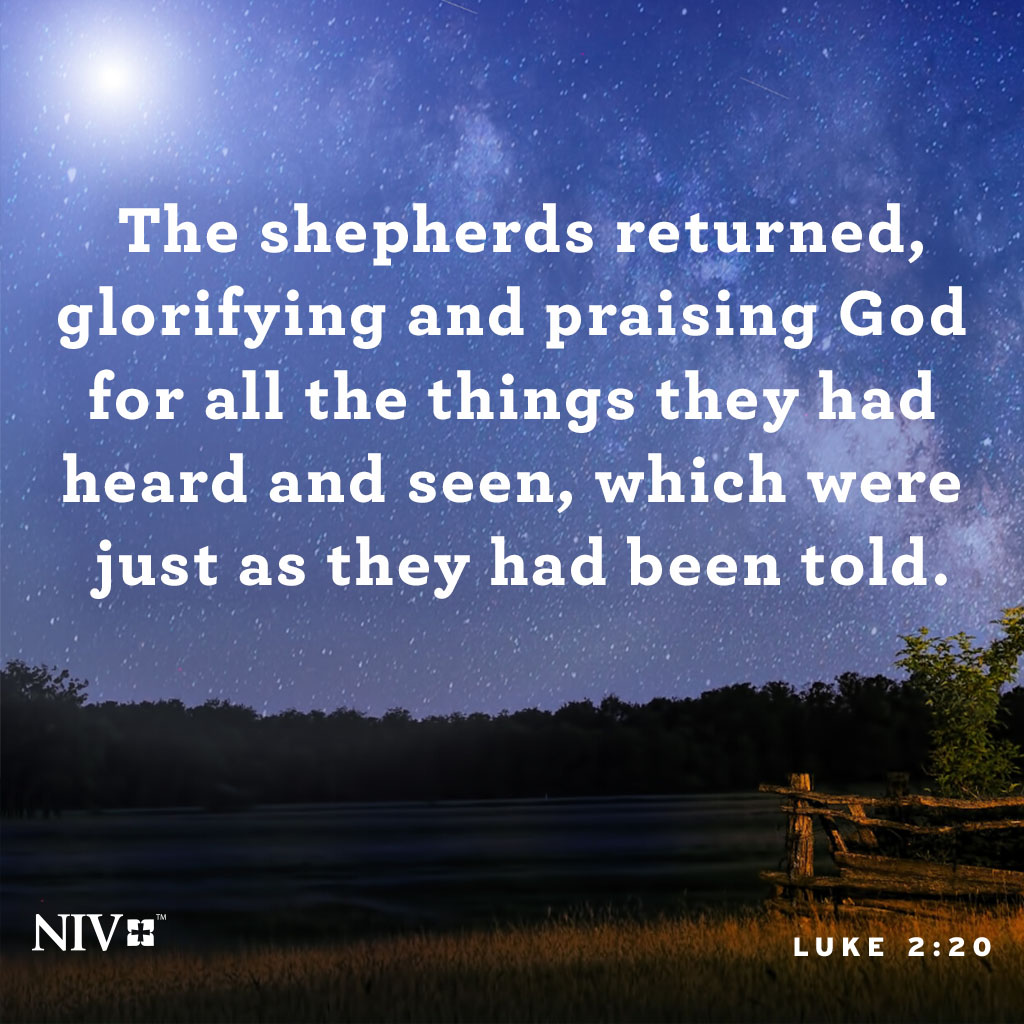
“The shepherds returned, glorifying and praising God for all they had heard and seen, as it had been told them.” (Luke 2:20)
Luke doesn’t tell us how long the shepherds stayed at the stable. Were they there for a few minutes, or did they spend a much longer time at this holy moment? Luke does tell us that the shepherds returned to their work as shepherds. Someone still had to watch over the sheep. They still had to make a living and help support their families. As great as the stable moment was, the shepherds returned to everyday life. Yet, as Luke writes, they “returned glorifying and praising God for all they had heard and seen.” They returned to their lives, just not the way they first left them to visit the Bethlehem manger.
As we seek to discover God’s will, we must still live our lives. While there are times to pull away from the world in contemplative prayer and thought, at some point we must re-engage with the world in which we live. We seek discernment about our lives, and thus, we must take what we discover and apply it to our daily living. While it is tempting to stay on the mountain peak with God, we eventually must go back to the valleys and live out God’s will.
The world around us is still looking to find its way. As Jesus’ followers, we are called to bear witness to the way, the truth, and the life that is Jesus. The Light of the World has now made us lights in the world to reflect the glory of the only begotten Son of God. We who follow the Light, must now bear witness to the Light. We must go or return to wherever God has placed us and live as the shepherds did, “glorifying and praising God for all they had seen and heard.”
Prayer: O Lord of Light, help me to live as your light in the world so others might experience you in a way that brings light into their darkness.
“But Mary treasured all these words and pondered them in her heart.” (Luke 2: 19)
The heart and mind of Mary. What was it like to be Mary as the shepherds retold their story to her and Joseph in their stable setting? So much had already happened to Mary. From Gabriel’s visit announcing to her the impending pregnancy, to explaining it to Joseph, the trip to Bethlehem, a stable birth, and now a visitation by local shepherds. How does one person digest all that transpired? Luke writes that Mary treasured and pondered everything in her heart. It is a reflective moment for Mary, a holy pause where she considers what God has brought about. Such a moment required deep reflection in light of God’s miracle.
If spiritual discernment is anything, it is deep reflection. Life can easily speed by us without leaving us any time to reflect on what happened. One event moves quickly into another, and we move with it. Discernment, however, is a holy pause where we consider what God is doing and revealing to us. Like Mary, we must ponder and treasure each moment and learn from them. As we consider each part of our lives, we prayerfully place each part in God’s light so God might show us what it means for us going forward.
The psalmist would proclaim, “Be still and know that I am God.” (Psalm 46:10) This stillness does not come easy to us in our fast-paced society. Life moves so very fast. Therefore, as Christians, being still and listening for God’s word is a discipline that requires a commitment to pacing ourselves so that God’s word is not drowned out by the noise of our world. In such stillness, we can discover that our God is speaking to us about our lives, and offering words of comfort, assurance, and direction. Like Mary, we must treasure these words and ponder them in our hearts.
Prayer: Help me to be still and to listen to your word, O Lord.
“When they saw this, they made known what had been told them about this child, and all who heard it were amazed at what the shepherds told them.” (Luke 2: 17-18)
Everybody loves a story, especially a good story. A story that invites you in and allows you to feel as though you were there in the drama. People also love good storytellers. These individuals know how to weave a tale together that holds our attention and remains with us later.
The great Russian novelist Fyodor Dostoevsky once wrote, “But how could you live and have no story to tell?” Life is about stories. Stories that involve us as well as stories that involve those we know. The moment we are born, we begin our own story as our life develops and moves and transitions over time. To live is to have a story.
The shepherds now had a story to tell. As they visit with the new parents and the infant Jesus in their stable accommodations, they relate to them the miraculous story of their angelic visitation. Whether there were more people at the stable than Mary and Joseph, we are not told, but all who did hear their story were amazed.
Discernment is about a spiritual reflection of one’s story, whether it be an individual or a church. We must listen to our stories, consider the people and places in them, the events that happen, and the emotions we feel along the way. Most important is we must ask ourselves how God fits into the story. What role does God play in our stories? What influence does God have upon our stories? And are our stories honoring God in the way they are told and lived? In listening to our own stories, we can discover how God has worked in the past, continues to work in the present and the promise of his presence in the future. God loves stories and desires nothing more than to be a part of ours.
Prayer: Thank you, Lord, for the stories. Thank you for my story. That you for the old, old story of Jesus and his love.
“So, they went with haste and found Mary and Joseph and the child lying in the manger.” (Luke 2:16)
Emily Dickinson once wrote, “Not knowing when the dawn will come, I open every door.” You might say it is the poet’s way of saying, “do not let an opportunity pass you by.” Life presents us with different opportunities over the course of our living. Opportunities we may take, or we may refuse. It is always our choice.
The shepherds on the Bethlehem hillside made a choice to go and seek out the baby the angels had told them about. They could have received the good news of the Messiah’s birth and remained where they were. They could have passed on the opportunity to experience this holy birth. Instead, with “haste,” they went out and found the baby lying in a manger just as the angel had said. They would not let this opportunity pass them by.
In discerning God’s will, we must take advantage of the opportunities that God brings into our lives. When God opens a door for us, it takes faith to walk through it. It requires faith because, at that moment, we might not see the benefit of walking through the door. We might be afraid of what is on the other side. God doesn’t always reveal everything to us at one time. We will still have doubts, questions, and uncertainties as we follow God’s will for our lives. Yet, we must take the opportunity that is there and trust that in doing so, God will bring us to where we need to be.
The shepherds took advantage of their opportunity and were one of the first ones to encounter the infant Jesus. They now shared in the blessing of being part of God’s miraculous work in the world. We, too, can share in God’s miracles when we step out in faith, take the doors that are open to us, and seize the moment. Moments that can be transformative and life changing. Miracles happen every day, and we can experience them when we step out in faith at each opportunity.
Prayer: Help me, Lord to say yes to the opportunities you present to me and step out in faith in response.
“When the angels had left them and gone into heaven, the shepherds said to one another, ‘Let us go now to Bethlehem and see this thing that has taken place, which the Lord has made known to us.” (Luke 2:15)
When the hillside turned dark after the angels departed, the shepherd decided to go together to see the child they were told about. How long did it take them to reach the stable, and what did they talk about along the way? Perhaps they were so overwhelmed that they talked excitedly about what would happen next. Or perhaps they walked in stunned silence on their way to Bethlehem. The scripture does not tell us. All they said to one another was, “let us go.” They would go together.
In Jesus, we are called into a community of faith. In our Christian journey, we walk with one another. While we each have an individual relationship with God, God calls us to share our lives with other Jesus followers. Our faith is a joint adventure where we walk together as Jesus’ disciples. The apostle Paul would write in his letter to the church at Rome: “so we, who are many, are one body in Christ, and individually we are members one of another.” (Romans 12:5) We belong to one another.
Discernment rarely takes place in isolation. Together we encourage, support, challenge, and love one another as we seek to discover God’s will. As the church, we are one body, and thus we seek to discern God’s will through unity and mutual affection. As Paul states, “Therefore encourage one another and build each other up, just as in fact you are doing.” (1 Thessalonians 5:11) As the song says, “We all get by with a little help from our friends. We are in this together as the church. Through the ups and downs of community life, we find God’s strength in one another. We discover God’s will together.
Prayer: Thank you, Lord, for those who journey with me as my brothers and sisters in Christ.
“And suddenly there was with the angel a multitude of the heavenly host, praising God and saying, Glory to God in the highest heaven, and on earth peace among those whom he favors!” (Luke 2: 13-14)
It was no longer a silent night on the Bethlehem hillside. The shepherds were suddenly met with a chorus of angels crying out in praise for God’s great gift in Jesus. As the old Christmas carol states, “Hark the herald angels sing, glory to the newborn King.” The joy of Christmas would not be limited to the earthy realm of Bethlehem, but even heaven was joining in the party. Heaven itself was moved with Jesus’ birth.
In Jesus, heaven came down and fully entered our earthly existence. The Bethlehem babe came to be the bridge between our world and heaven’s glory. This divine-human connection would forever change us, but it would also change heaven.
In our daily lives, heaven pays attention. The psalmist would proclaim, “For He will command His angels concerning you to guard you in all your ways. On their hands they will bear you up, lest you strike your foot against a stone.” (Psalm 91: 11-12) Now the Bible does not tell us that every person has a guardian angel like Clarence is to George Bailey in the holiday film, It’s A Wonderful Life. However, we do know that God’s angels care about us, and they can intervene in our lives as they are called by God. Jesus would teach in his parables of the lost sheep, coin, and son, “In the same way, I tell you, there is rejoicing in the presence of the angels of God over one sinner who repents.” (Luke 15) Heaven just seems to have a connection with you and me.
I like to think that in our lives, heaven is rooting for us as we live out our lives. The angels on the first Christmas celebrated with the shepherds the good news of Jesus’ birth. Heaven celebrates with us as well. God’s chorus of angels cheers us on as we live in our earthly home. This is good news. In our every day living, heaven pays attention.
Prayer: May your holy angels watch over me always.
“This will be a sign for you: you will find a child wrapped in bands of cloth and lying in a manger.” (Luke 2:12)
The angels inform the shepherds that they are to look for a sign that this birth has taken place. Traveling to Bethlehem, what were they to look for? The angelic message is that the sign will be a child wrapped in bands of cloth and lying in a manger. Indeed, a newborn infant lying in a feeding trough would be a sign of all time.
The late Henri Nouwen, in his book’s preface, Discernment: Reading the Signs of Daily Life, states, “God is always speaking to us – individually and as the people of God – at different times and many ways: through dreams and visions, prophets and messengers, scripture and tradition, experience and reason, nature and events.” Discernment is the spiritual practice of trying to understand what these signs mean.
Through prayer, we seek to come to an understanding of how the signs in our lives speak to us. What message are we to learn from them? These signs are gifts of God’s grace to help show us the way. They are like lights in the darkness which give us glimpses of God’s will for our lives. These lights help us find our way when we are uncertain of the path before us. They are signs which reveal God’s word to us when we are searching. Psalm 119: 105 says, “Your word is a lamp to my feet and a light to my path.”
The baby in a manger would be a light to the feet of a dark world. Shepherds, magi, tax collectors, prostitutes, the lame, the poor, the blind, the helpless, the hurting, the broken would all see the sign. This sign would make all the difference for them. It makes all the difference for us as well.
Prayer: Help me to see the signs you place in my life and the light of your presence they display.
“But the angel said to them, ‘Do not be afraid; for see—I am bringing you good news of great joy for all the people: to you is born this day in the city of David a Savior, who is Christ, the Lord.” (Luke 2: 10-11)
Over the course of my ministry, I have had to be the bearer of both good and bad news. Events interrupt a normal day with news that must be shared. If it is bad news, it can be a challenge to figure out a way to tell those affected. How do you break the news to someone when you know that it will be devastating for them to hear? On the other hand, sharing good news with another can be a joyful experience and you can hardly wait to share it.
The shepherds who were watching over the flocks by night in the Christmas story receive good news from the angels. The darkness of the night is awakened by the light of God’s glory in the angels’ appearance. While scared at first at what they were witnessing, the shepherds would soon discover that they were the recipients of good news: “to you is born this day in the city of the David a Savior, who Christ the Lord.” Their lives would now be overturned by good news. Good news which would redirect their lives.
In our lives, both good news and bad news can redirect our lives. Life is interrupted by an event or situation which causes us to reexamine our lives, our direction, and what our ultimate destination is. Such events are often unexpected and leave us wondering what is next. The shepherds would have to choose what to do with this news. When life interrupts, we, too, have the freedom to choose how we respond. Discernment involves making decisions. Discernment includes both rational and intuitive processes: it means taking stock of your situation, your circumstances, the movements of your soul. It entails paying attention to your reactions, observing your physical and spiritual responses to things around you.
The shepherds would have to decide what to do with this news. We, too, must decide what to do when the news changes our situation.
Prayer: Help me, Lord make sense of the news that interrupts my life in such a way that honors you.
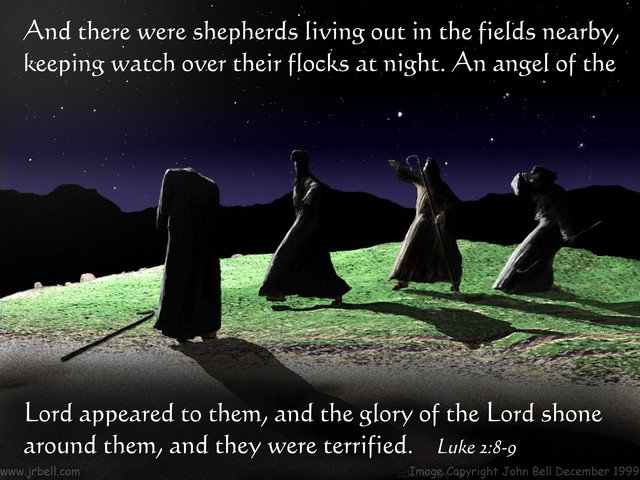
“In that region, there were shepherds living in the fields, keeping watch over their flock by night. Then an angel of the Lord stood before them, and the glory of the Lord shone around them, and they were terrified.” (Luke 2: 8-9)
For the first time, unnamed individuals enter the Christmas story. Shepherds watching over their flocks by night encounter heavenly messengers on a Bethlehem hillside. Shepherds watching over sheep was a common site at the time of Jesus’ birth. They were hardworking individuals who looked over some of the most vulnerable creatures. It was not a lucrative occupation, but it provided a steady living. These were ordinary folks doing ordinary work. God would use them, however, in the Christmas story.
God often brings individuals into our lives that make a difference in our stories. These unexpected visitors may be with us for only a brief time, but they impact us in life-changing ways. They often intersect our lives when we least expect them. Yet, something about their story influences our own.
In discerning God’s will in our lives, we must pay attention to the people around us. God often uses others to reveal himself to us in ways that we are not expecting. Through the lives of others, we sometimes receive glimpses of God. In Hebrews 13:2, we read, “Do not forget to show hospitality to strangers, for by so doing some people have shown hospitality to angels without knowing it.” The shepherds were not angels, but they did experience the glory of God on that Bethlehem hillside. They indeed would become “messengers” of God’s good news as the first Christmas unfolded.
Prayer: Lord, help me to pay attention to the people in my life and how You might be using them to speak to me.
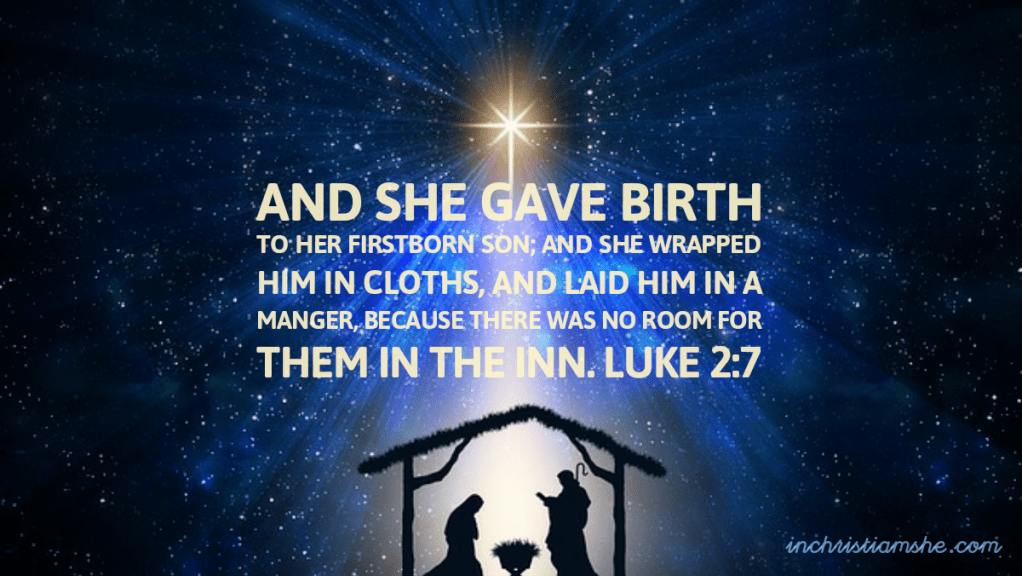
“And she gave birth to her firstborn son and wrapped him in bands of cloth and laid him in a manger because there was no place for them in the inn.” (Luke 2:7)
Perhaps one of the most well-known parts of the Christmas story is when Mary and Joseph arrived in Bethlehem and could not find any place to stay. With so many individuals in town because of the census, accommodations were few. We can imagine Mary and Joseph going place to place looking for somewhere to stay. Turned away repeatedly, the expecting couple found rest in a stable. Jesus is born, and Mary places him in a feeding trough as a cradle. When they dreamed of Jesus’ birth, they could not have imagined it turning out the way it did. Homeless and on the road, they were in an in-between time.
A lot of life is lived during in-between times. We find ourselves on a journey but not yet at our destination. The Bible is full of stories of such journeys. Most notably, there is the story of the people of Israel after their liberation from slavery in Egypt. They were no longer slaves, but they still did not have a place to call their own. They spent years traveling in the desert on the way to the promised land. As we read the stories from the book of Exodus, these were challenging times for God’s people. They were in-between times.
It is during these times that we must trust that God is present with us. Our situation may not be ideal, but God is with us. Jesus is our Emmanuel, meaning God with us. When Mary placed Jesus in a wooden manger, God brought stable time to our in-between times. We might not be where we want to be, but God is right where we need him to be.
Prayer: During the in-between times may we can experience stable time.
“While they were there, the time came for her to deliver her child.” (Luke 2:6)
Timing is everything. I’m not sure this statement can be attributed to any one person. However, it is a statement that I think most people would agree with. Timing can often make all the difference in how an event unfolds or an outcome is reached.
The song Turn, Turn, Turn became an international hit in late 1965 when it was adapted by the American folk-rock group the Byrds. The folksy lyrics became part of a generation of turmoil. Yet, we must step back in time to the Book of Ecclesiastes in the Old Testament to find the source of the song. It was the writer of Ecclesiastes who said, “For everything, there is a season, and a time for every matter under heaven.” (Ecclesiastes 3:1)
Luke tells us that Mary and Joseph were in Bethlehem when the time came for Mary to deliver her child. If Luke was a physician, as we suspect, he knew that a normal pregnancy took nine months. Luke 2 records that the time came for Mary. Yet, it might mean more than simple “clock” time. Perhaps Luke was sharing that it was the pivotal moment in time in which God would step into the world in human flesh. This was a holy moment where heaven intersected the earth, and Jesus was born. This seems to be what the Apostle Paul alluded to when he wrote in his letter to the Galatians, “But when the set time had fully come, God sent his Son, born of a woman.” (Galatians 4:4) This was all about God’s timing.
As we seek to discern God’s will for our lives, timing is everything. We must seek to match our lives to God’s tempo. We cannot rush ahead, nor can we lag. Through prayer, scripture, worship, and conversation, we live into God’s timing. As the psalmist would proclaim, “I trust in You, O LORD; I say, “You are my God. My times are in Your hands.” (Psalm 31:14-15)
Prayer: My times are in your hands, O Lord. Help me to trust in you.
“In those days, a decree went out from Emperor Augustus that all the world should be registered. This was the first registration and was taken while Quirinius was governor of Syria. All went to their own towns to be registered. Joseph also went from the town of Nazareth in Galilee to Judea, to the city of David called Bethlehem, because he was descended from the house and family of David. He went to be registered with Mary, to whom he was engaged and who was expecting a child.” (Luke 2:1-5)
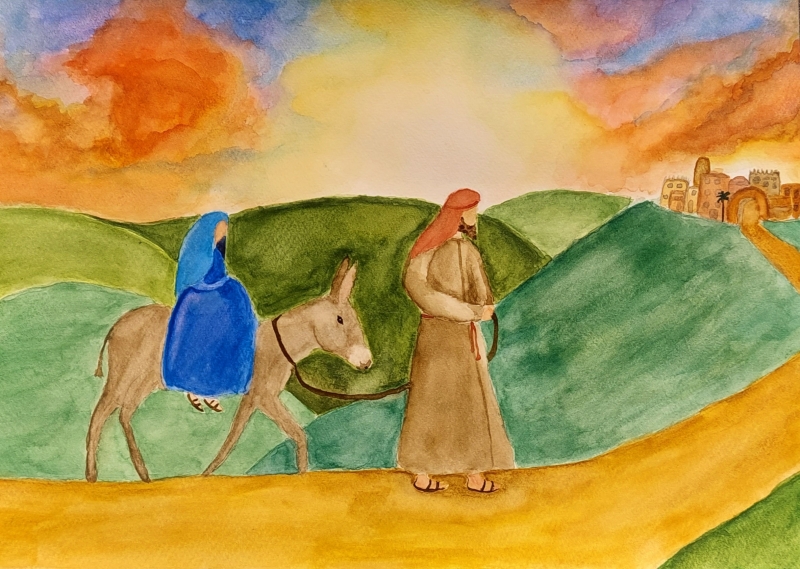
Mary and Joseph were out of towners when they gave birth of Jesus. The Roman Emperor Augustus had declared a census that required every individual to return to their hometown to be registered. Mary and Joseph packed their bags, left Nazareth, and headed to Bethlehem. They had to travel 90 miles to the city of Joseph’s ancestors: south along the flatlands of the Jordan River, then west over the hills surrounding Jerusalem, and on into Bethlehem. It was a grueling trip. The familiar pictures of Mary riding on a donkey with Joseph leading have become an iconic image at Christmas. As God’s plan of salvation became a reality, it would require Mary and Joseph to move. It would be a journey.
Discerning God’s will for our lives can be understood as a journey. While there are times when God speaks very directly to us about a situation, like Moses at the burning bush, much of understanding God’s will takes time. While Moses encountered God in a bush, it took a long time to reach that point in his life.
Mary’s encounter with the angel Gabriel was just the beginning. Babies aren’t born overnight, and her pregnancy would include the trek from Nazareth to Bethlehem. While it was a literal journey that could be mapped out, I imagine that both Mary and Joseph felt as though they were on an inner journey with their lives as individuals and as a couple. Where would this journey take them as the soon-to-be parents of Jesus? What did it mean for the rest of their lives?
Discernment is a journey. It takes time. There are good days when God’s will seems clear to us and other days when we feel as though we don’t have a clue about what is going on. Faith is about trusting God while we are moving as well as when we are standing still. Just as Mary and Joseph’s journey was trying at times, so too ours will be as well. Yet, like these soon-to-be parents, we walk by faith, not by sight, trusting that God will bring to pass that which God desires in our lives.
Prayer: Help me to move when you call and to be still when you ask me to. May my journey follow your leading.
“He has helped his servant Israel, in remembrance of his mercy, according to the promise he made to our ancestors, to Abraham, and to his descendants forever.” (Luke 1: 54-56)
As Mary concludes her song of praise, she remembers that she is part of a larger story. Mary does not live as an island to herself, but she is part of a greater narrative of God’s relationship with the people of Israel. Mary recognizes that what God is doing in the present is tied to the past. Her story is intricately tied to the story of a people. God long ago had called Abraham and Sarah to begin a journey with him that would ultimately bring God’s blessing to the entire world. What God was doing now in Mary’s life was part of the same journey. Mary was not beginning from scratch. She had a history that propelled her forward.
In our Christian walk, we too are part of a larger story going all the way back to the first Christians. Those early followers of Jesus who gathered as the church are the foundation upon which our lives are built as individuals as well as a church. Likewise, this foundation is made up of individuals from our most recent history. Every Christian and every church have a family tree that has helped bring them to where they are today.
When we are seeking to discern our future, we must never forget where we’ve come. This doesn’t mean that we must be and do everything just like those who went before us, but it does call us to honor those who lived out their faith before us so we might live out our faith today. We need to remember our foundation in gratitude to God. God has blessed us with generations of saints that came before us. We must never forget their story.














 Conversations from the Couch